“The question of authorship in the era of artificial intelligence does not disappear; rather, it transforms into new, more complex and distributed forms.” – Mgr. Paulína Grolmusová
Artificial Art and Authorship in the Age of Artificial Intelligence explores how generative artificial intelligence is transforming traditional understandings of authorship, creativity, and the artistic process in contemporary digital culture. The thesis combines philosophical and cultural studies approaches from postmodernism, transhumanism, and posthumanism with an analysis of contemporary AI art. It reflects on the question of who the author of an artwork is today – whether it is the human, the algorithm, or a complex technological system.
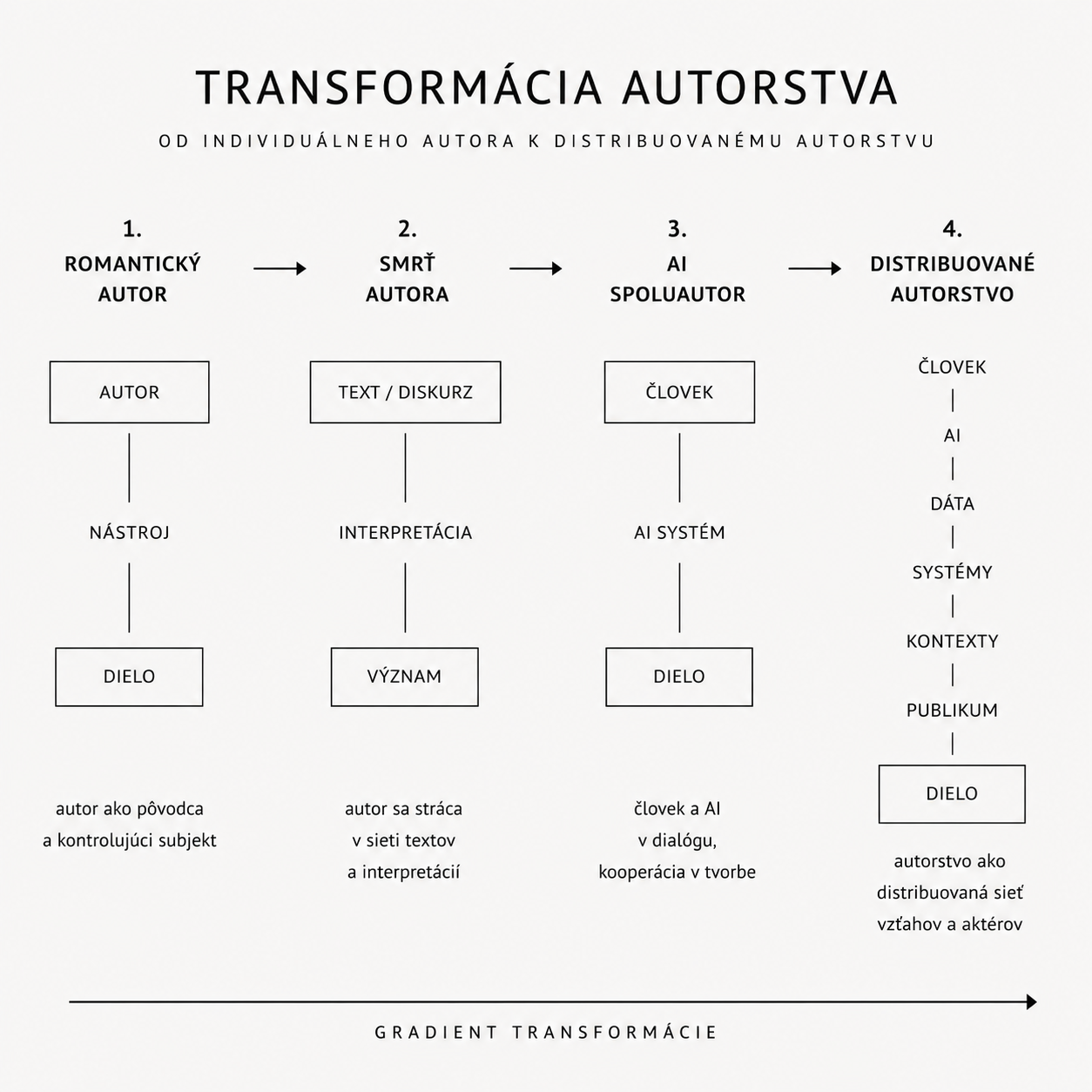
The theoretical part of the thesis is dedicated to the historical development of the concept of authorship, from the romantic notion of the author as a genius to the post-structuralist theories of Roland Barthes and Michel Foucault. It then analyzes the transformation of the subject and the emergence of new models of authorship under conditions of algorithmic culture. The thesis also includes an original typology of authorship models, distinguishing between conservative, transhumanist, and posthumanist approaches to artistic creation.
The next part focuses on the analysis of selected artistic projects working with artificial intelligence, such as Refik Anadol (Unsupervised), Obvious (Edmond de Belamy), Anna Ridler (Mosaic Virus), and Sougwen Chung. Through these case studies, the work demonstrates different forms of collaboration between humans and technology and reflects on issues of originality, authenticity, distributed authorship, and the role of the viewer.
The final section addresses the impacts of AI art on cultural institutions, the art market, and arts management, as well as the environmental, ethical, and legal aspects of generative artificial intelligence. The thesis understands artificial art not only as a technological phenomenon but primarily as a cultural symptom of the present, fundamentally changing the way we think about creation, identity, and the future of art.