The G18 university gallery balances on the fine line between dynamic artistic operations and a cumbersome academic apparatus. Surprisingly, the most critical threat to its smooth operation is not the creative or technical complexity of the exhibitions themselves, but rather personnel instability and the constant loss of operational know-how. The entire weight of production operations often rests on a single employee, who relies on frequently rotating student teams during implementation. With every turnover of the student body, the institution loses its memory, meaning the onboarding process must always start from scratch. This situation is further complicated by the necessity of asymmetrical communication with external artists and the heavy bureaucratic burden associated with the university’s approval processes.
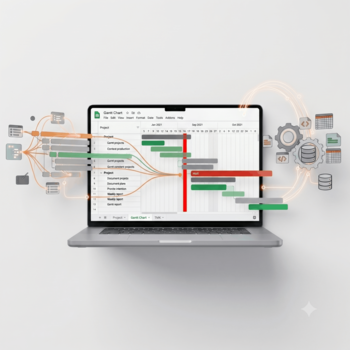
As a direct solution to this problem, an adaptive suite of production tools was developed—a software prototype tailor-made for gallery operations. Built in the accessible environment of Google Sheets and utilizing advanced automation scripts, this cloud-based tool integrates a Work Breakdown Structure (WBS), a Responsibility Assignment Matrix (RACI), and a dynamic Gantt chart. Its purpose is not to restrict the creative process within rigid corporate structures, but rather to take on the burden of operational tasks. The tool efficiently filters tasks, generates a clear personal dashboard for each team member, and transforms unwritten practices into tangible institutional memory. It thus provides students with a solid framework for rapid adaptation while introducing principles of sustainable management into cultural operations—preventing staff burnout and freeing up capacity for the creation of high-quality exhibitions.